Backbone
The backbone is the part of the force field that needs no experimental data. It makes the beads behave like a chromatin fibre: a connected chain with some stiffness that cannot pass through itself. All other forces act on top of it.
In plain words
Think of a string of pearls. Each pearl is tied to its neighbours by a short spring (bond), the string resists sharp bending like a garden hose (angle), and no two pearls can sit in the same place (excluded volume, a kind of personal space).
Bonds
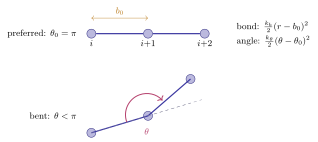
Consecutive beads are connected by a harmonic spring,
where \(r_{i,i+1}\) is the distance between beads \(i\) and \(i+1\), \(b_0\) is the rest length and \(k_b\) the stiffness. With the defaults a bond fluctuates by only \(\sqrt{k_BT/k_b}\approx 0.003\) nm, about 3% of \(b_0\), so the chain is practically inextensible: bonds define connectivity, not elasticity. Bonds are not created across a chromosome boundary, so every chromosome is its own chain.
Why this force, and what does it model?
DNA is a continuous molecule, so neighbouring beads must stay neighbours. A stiff spring is the simplest way to say this, and a spring is also what the computer handles best: its energy is smooth and its force is easy to compute. The spring is made so stiff that the chain is practically inextensible, so it models connectivity, not stretchiness.
Angles (stiffness)
Chromatin cannot bend arbitrarily sharply. Stiffness is a harmonic term on the angle \(\theta_i\) formed by three consecutive beads,
With \(\theta_0=\pi\) the preferred shape is a straight line and \(k_\theta\) penalises bending. Bond plus angle form a discretised worm-like chain. In the weak-bending limit its persistence length (the contour length over which the chain keeps its direction) is about
This is only a guide, because excluded volume and the data forces also bend the chain, but it shows how to tune stiffness: doubling \(k_\theta\) roughly doubles \(\ell_p\).
Why this force, and what does it model?
Chromatin has a real thickness, so the fibre cannot pass through itself. Without this term the chain would collapse into a point, or pass through itself like a ghost, which topoisomerases and the physical fibre forbid. The angle term models the fact that a 10 nm to 30 nm fibre is not a floppy thread but resists sharp bends (the persistence length is the distance over which it keeps its direction).
Excluded volume
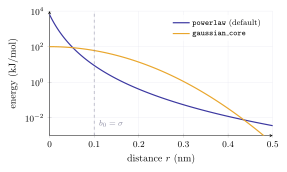
Two beads must not occupy the same place. A repulsive, soft-core interaction acts between all pairs of beads, including chain neighbours. Two functional forms exist; both use the size \(\sigma\) (set from LE_HARMONIC_BOND_R0, 0.1 nm) and the strength \(\varepsilon\).
EV_FORCE_TYPE |
Energy per pair | Character |
|---|---|---|
powerlaw (default) |
\(\varepsilon\left(\dfrac{\sigma}{r+r_s}\right)^{n}\) | Steep repulsion that grows quickly as beads approach. The small length \(r_s\) (EV_R_SMALL) keeps it finite at \(r=0\), where it equals \(\varepsilon(\sigma/r_s)^n\) (6400 kJ/mol for the defaults), so the minimiser never meets an infinity. At \(r=b_0\) it is only about 9 kJ/mol, so chain neighbours feel a mild, nearly constant offset. |
gaussian_core |
\(\varepsilon\,e^{-r^2/(2\sigma^2)}\) | A very soft core: finite (\(=\varepsilon\)) at full overlap and negligible beyond about \(3\sigma\). It lets beads pass through each other, which is useful when a structure is badly crowded and needs to relax. It uses neither \(n\) nor \(r_s\). |
In MultiMM
| Term | Keys | Defaults |
|---|---|---|
| Bond | POL_USE_HARMONIC_BOND, POL_HARMONIC_BOND_R0 (\(b_0\)), POL_HARMONIC_BOND_K (\(k_b\)) |
True, 0.1 nm, 300 000 kJ mol⁻¹ nm⁻² |
| Angle | POL_USE_HARMONIC_ANGLE, POL_HARMONIC_ANGLE_R0 (\(\theta_0\)), POL_HARMONIC_ANGLE_CONSTANT_K (\(k_\theta\)) |
True, 3.14159 radian, 100 kJ mol⁻¹ rad⁻² |
| Excluded volume | EV_USE_EXCLUDED_VOLUME, EV_FORCE_TYPE, EV_EPSILON (\(\varepsilon\)), EV_POWER (\(n\)), EV_R_SMALL (\(r_s\)) |
True, powerlaw, 100 kJ/mol, 6, 0.05 nm |
The excluded-volume size \(\sigma\) has no key of its own: it is read from LE_HARMONIC_BOND_R0 (default 0.1 nm, equal to \(b_0\)). The Hi-C force also uses it as its minimum distance. Angles are omitted at chromosome boundaries.
Rule of thumb
Leave the backbone at its defaults unless you have a reason. If the structure looks too crumpled or too straight on short scales, adjust POL_HARMONIC_ANGLE_CONSTANT_K first.