Scope: what the model explains
Before the details, one question: what do we want from a model of loop extrusion? This page sets the goal and the logic of the approach. The next pages explain the physics (Mechanics), the sampling (MCMC) and the 3D polymer (Molecular dynamics). For the biology of cohesin and CTCF see Loop extrusion.
From rules to a heatmap
A Hi-C map is a matrix: entry \((i,j)\) counts how often two regions \(i\) and \(j\) of the genome were found close together in space. It shows patterns: squares along the diagonal, dots at their corners, lines called stripes, and a checkerboard. The model asks a generative question: which small set of rules produces these patterns, without drawing any of them by hand?
The rules of loop extrusion are few. A ring (cohesin) loads on the fibre. It extrudes a loop. CTCF can stop it. Rings do not cross each other. Because the process is random, a single moment is one random set of loops. The contact map is the average over many such sets: two regions are in contact often when many of the sets have a loop between them.
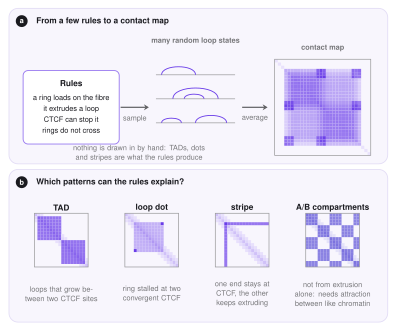
Which patterns can occur
TADs (topologically associating domains) are squares along the diagonal: regions that contact each other more than their surroundings. They appear when loops grow between two boundaries and cannot leave the domain.
Loop dots are single bright points at the corner of a domain. They appear when a ring is stalled at two anchors that face each other (convergent CTCF) and stays there for a long time.
Stripes are lines starting at one anchor. They appear when one leg of the ring is held at an anchor and the other keeps extruding, so the anchor touches everything along one side.
A/B compartments are a checkerboard: active (A) and inactive (B) chromatin each prefer their own kind. Extrusion alone does not make them, and it even weakens them by mixing the regions. They need an attraction between like chromatin, which LoopSage can add with the epigenetic model and the compartment force.
The two questions
The model has to answer two different questions, and it uses a different tool for each:
- Which sets of loops are likely? This is a question about probabilities. It is answered by an energy function and a Monte Carlo sampler (Mechanics and MCMC).
- What does the chromatin look like in 3D when a set of loops is present? This is a question about motion and shape. It is answered by molecular dynamics of a polymer (Molecular dynamics).
What the model is and is not
LoopSage is a statistical model of loops: it reproduces the distribution of loops and the average structure, not the movie of one cohesin ring in real time. Its parameters (\(N_{\mathrm{lef}}\), the energy coefficients, the temperature) are effective numbers, which the optimizer can fit to the data.